
The Business Challenge
As one of the largest state-owned bank in Indonesia, Bank BRI’s focus has always been the micro segment in Indonesia. With vast reach from urban to rural areas in the country, and hundreds of thousands of networks of bank agents, its mission has always been about financial inclusivity and providing financial access to the grassroot communities. From street vendors, market sellers, and blue collar workers.
However, as majority of the Indonesian population are still unbanked (or underbanked), relying on cash for their daily transactions and putting their wealth in a cupboard inside their homes, the Bank wants to find a way to capture the cash in circulation, and provide bank service to these micro segments.
Bank BRI then contacted the team at Somia Customer Experience, a design research consultant agency where I worked, to answer this particular design objective: How might we get people to save their money in the bank?
The Approach
The challenge working in Indonesian market is that the communities aren’t always homogenous. There are lots of differences in conduct, principles, or culture in different regions. So we worked closely with the bank to understand closer their business context, as well as finding the best location to do this study. We came up with 6 cities (combination of urban and sub-urban) areas in which we believe will be a good representation of the Indonesian population, and decided to do a full blown qualitative deep dive to our users.
The objective of this in-situ interviews and observation of course is to get a closer look at their life contexts, their money-managing behaviors, and discovering the gap between their lives and the bank’s service.
In the series of interviews, to understand their life values better, we not only talk to the participants of this study, but also immersed ourselves in activities and discussions with their closed ones, their community leaders, as well as talking closely with the local experts consisting of the local bank agents, and also the bank employees in those markets. The goal of this is to make sure we have a holistic view of the ecosystem and able to find gaps that we can close.
We also brought some seeds of services ideas and product ideas that we wanted to test to them. For this, we created series of lo-fi physical prototypes and let them to touch and directly interact with it. This approach allow us to really fit our initial ideas as close as possible with their life context, and we were able to get direct feedback on improving the product or services.
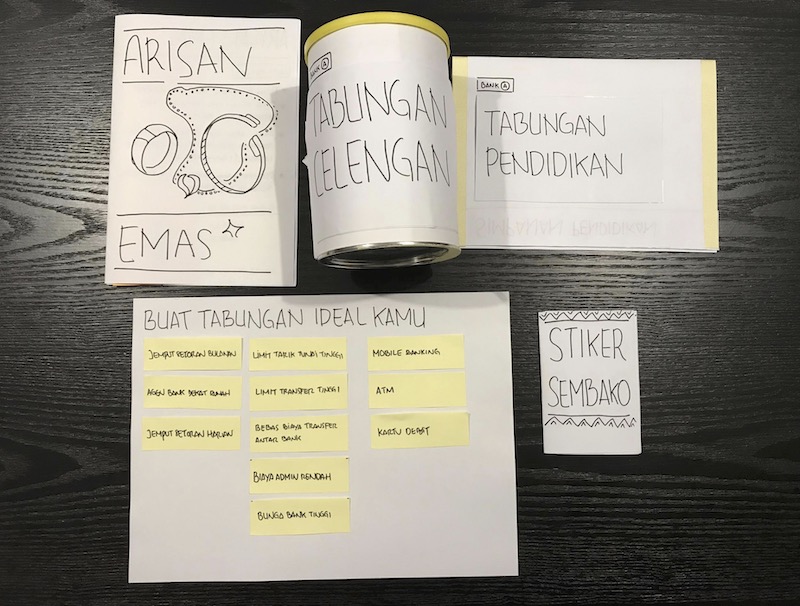
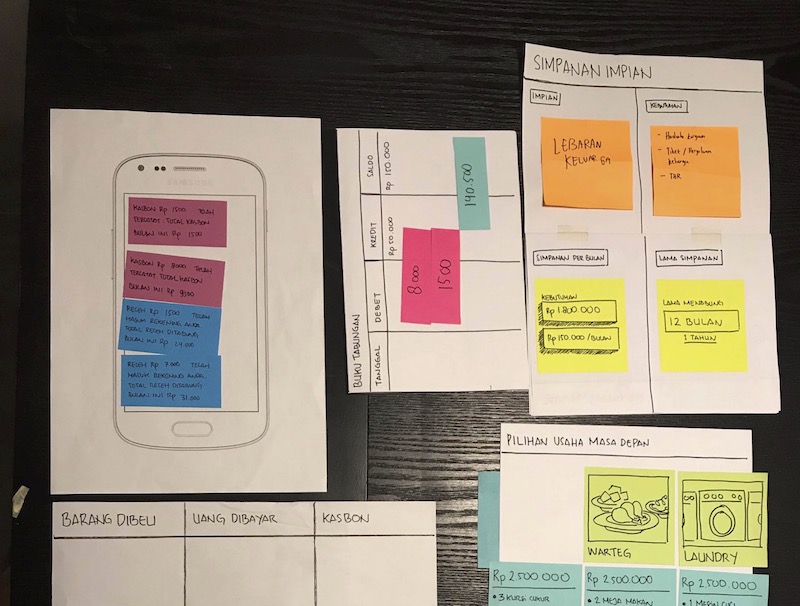
The Results
The insights we obtained in the field was enlightening not only for us the researchers in the field, but also the stakeholders in the bank side. We realized that we overlooked one simple barrier from the users side: To save their money in a bank, or to do any bank activities, there are often costs associated with it that are quite a burden for this segment to bear.
To get themselves from their homes to the bank, it costs them transport fees, parking fees, and also time. With majority of them depends on a daily income, this one simple insight does put a huge implication on the perceived barrier for them to do banking activities.
Furthermore, we also come to a realization that there are also emotional barriers for them to get to the bank. They might feel ashamed to only bring in a small amount of money to save daily (around IDR 50k or less), while having to watch the people around them might transact with bigger amounts. This is also one of the reason that these segments often rely on physical storage inside their homes.
Bringing forward the insights from this project, the researchers and the designers get together to create a service called Save Cash and Bank It. We combined a physical wallet design that can fit easily into their day-to-day context in the home, and also leverage the networks of bank agents that the bank already have. The physical wallet enable the users to store their cash conveniently in their homes, and also securing the cash even from themselves (their own impulses to spend).
Utilizing the network of bank agents, aleviates the barrier of going to a bank because it allows the users to interact with the people they already familiar with, and able to do saving transactions outside of the bank’s official operational hours.
After piloting this product / service to 3 regions in Indonesia, and series of iterations, we collected about USD 53 per person. This is a huge amount of savings compared to the pre-existing solutions that the segments have. It allows certain people who haven’t experience having a savings before, to finally have a bank account with money that they can use for their emergency funds / rainy days.
Furthermore, the team submitted this product / program to the IxD Awards in 2019 and received Best in Category Optimizing, as well as Best In Show.
Check out the product page under the IxDA page on the link below on further elaboration on how the product works.