
The Business Challenge
A prominent snack company in Indonesia was planning to diversify its offering into more types of wafer snacks. There hasn’t been any decision whether to target kids, teenagers, or adults. A foundational research is needed to uncover the roles of snacks in general, and where wafer snacks could fit into the users’ snacking repertoire.
The insights obtained from this research will be a direction to what wafer snacks will be created, what kind of flavor / texture, and who should this wafer snack be targeted to.
The Approach
From the research perspective, we translated the business challenge into ver specific areas for observation. Some of the key explorations are:
- Understanding users’ snacking usage and habits, learning from their current snacking behavior
- Breaking down snack products attribute to map out innovation areas
It was clear from the very beginning that this is going to be a full qualitative, foundational approach. The team initially thought of doing an ethnography approach, a full day kind of observation to understand where and when do snacks exists, and where do wafer snacks are preffered. But due to the limited budget and constraint, we decided that a regular focus groups can suffice, as long as we combine it with creative projection techniques and activities.
We broken the focus groups into 4 segments: kids, teenagers, young adults & first jobbers, and mothers.
To explore their snacking habits, we used lots of explorations like “a day in a life”, “shelf-drawing”, and “descriptive essays”. We asked the users to do these activities together, completing and commenting on each others until we collected a very vast visual and written data among their snacking habits.
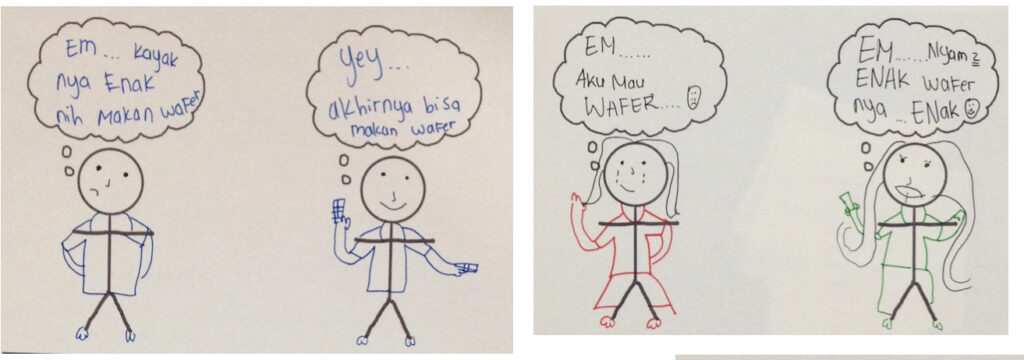
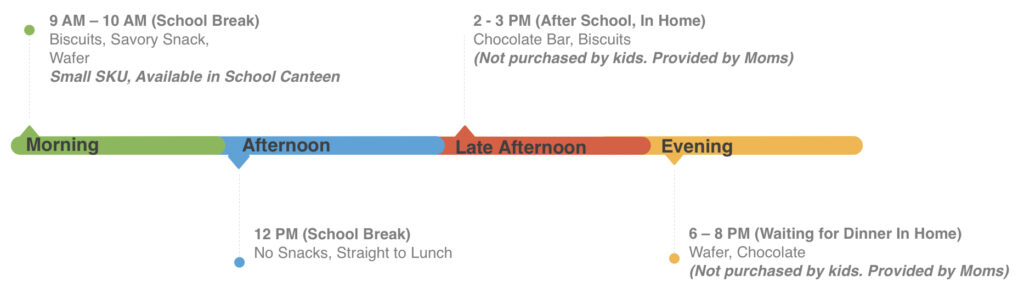
We also used narrative frameworks to help us dissect the product attributes of each different snack categories.
The Results
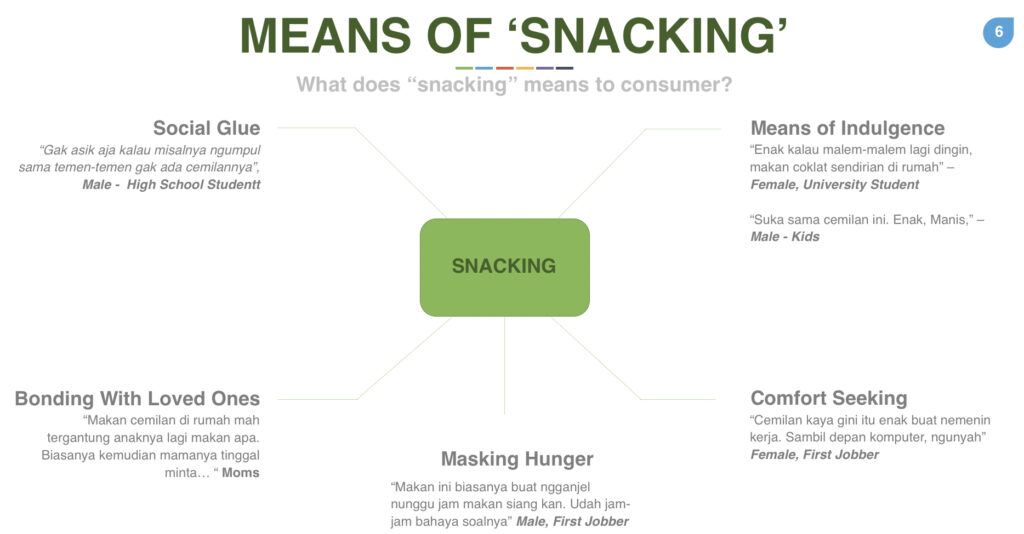
We successfully understand the different role of snackings that appear among different life stages. And we utilize this “main goal” of snacking as our base for new snack “design”
And synthesizing further from the product attributes data we get using the narrative framework, as well as the projective drawing / writing technique around different kinds of snacks, we also map out different roles of snacks, and utilize this quadrant as the potential white space for product development.

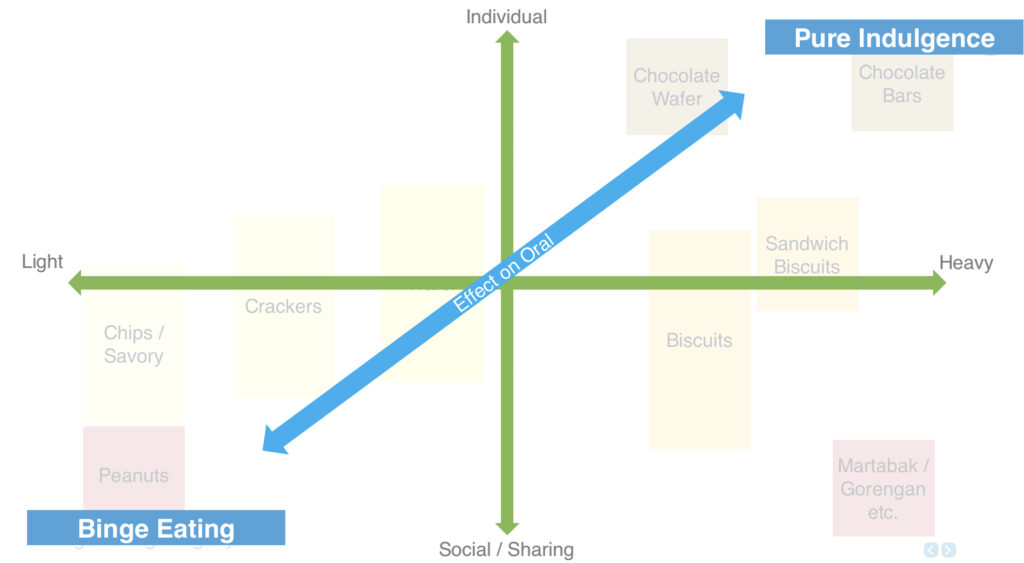
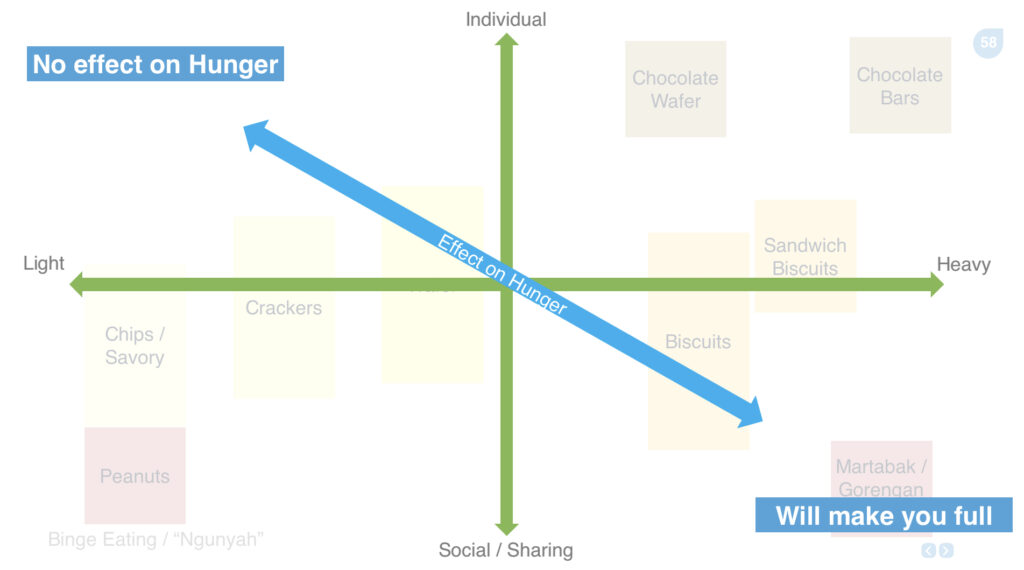
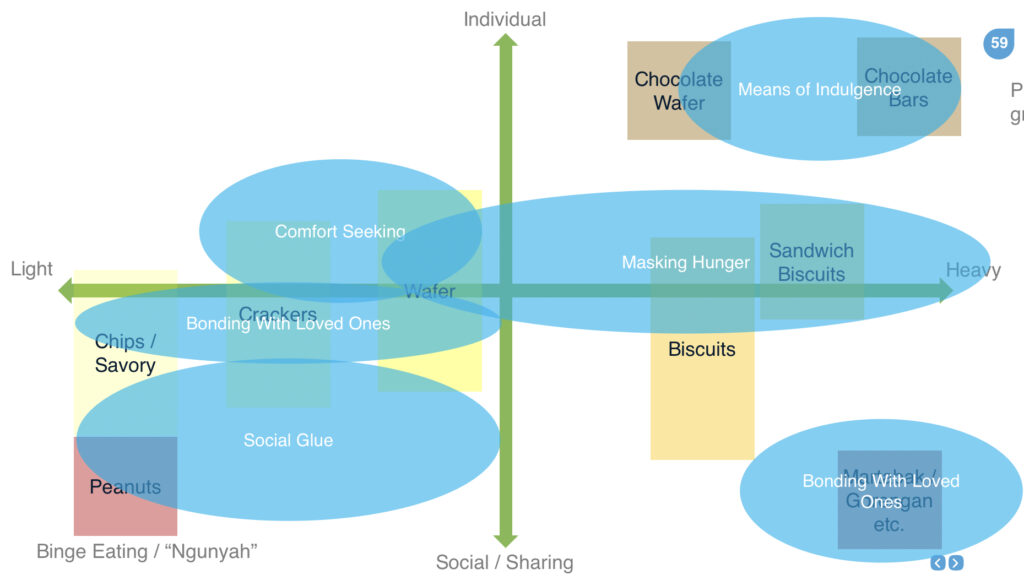
We recommended 3 routes for product development based on the white space above, expressed below.
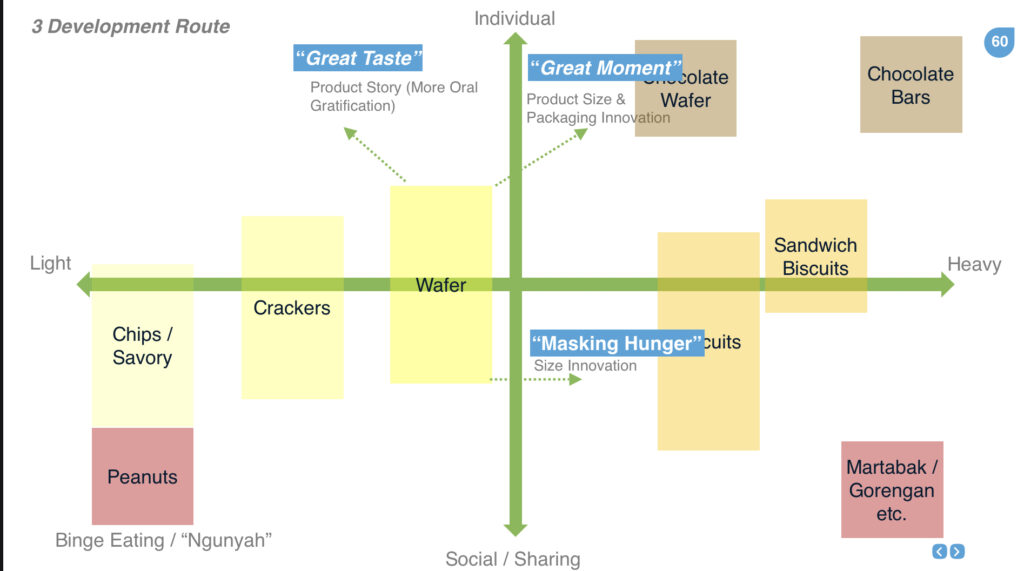
1 year after the research had been wrapped up, we finally are able to see the company’s new snacks in the retail market, and the insights we unearth from this research also inform them on what distribution channel / retail channel that the company should use in order to maximize exposure of the brand, and we also inform them on the best pricing point that might be perceived attractive among other snack competitors in the same space.