
The Business Challenge
Gopay started off as an exclusive payment method / e-money for Gojek services. Starting in 2018, the vision of the product is to finally extend their offering from an exclusive payment method / e-money for Gojek users, into the realms of offline payments, money managements, transfer solutions, and plethora of other possibilities including BNPL product.
Different users definitely have different products / key services relevant for them. However, creating a fully customized experience for each app, although attractive, is indeed out of the question
So how can we as product team prioritize what’s best to cover in our future home page? What are the things that have the most relevant to different user segments? Or what services serve as a foundation for all other GoPay products?
Research team is tasked to uncover this, helping the product team prioritize what makes the most sense to put in the GoPay homepage. Hopefully, to still have the best user experience.
The Approach
The approach that we have for this challenge is a combination of a qualitative and quantitative method.
The goal of the qualitative part is actually to uncover what are the themes of actions that our users usually do. Quantitative part of this approach is to actually size and measure the relevance of the themes we have on the qualitative part to all our users.
We’re lucky enough to have the results of the qualitative part at hand within our research repositories, within multiple research reports across time. So the utilization of the qualitative part is actually simplified with insights recycling. Illustration of the process goes something like this:
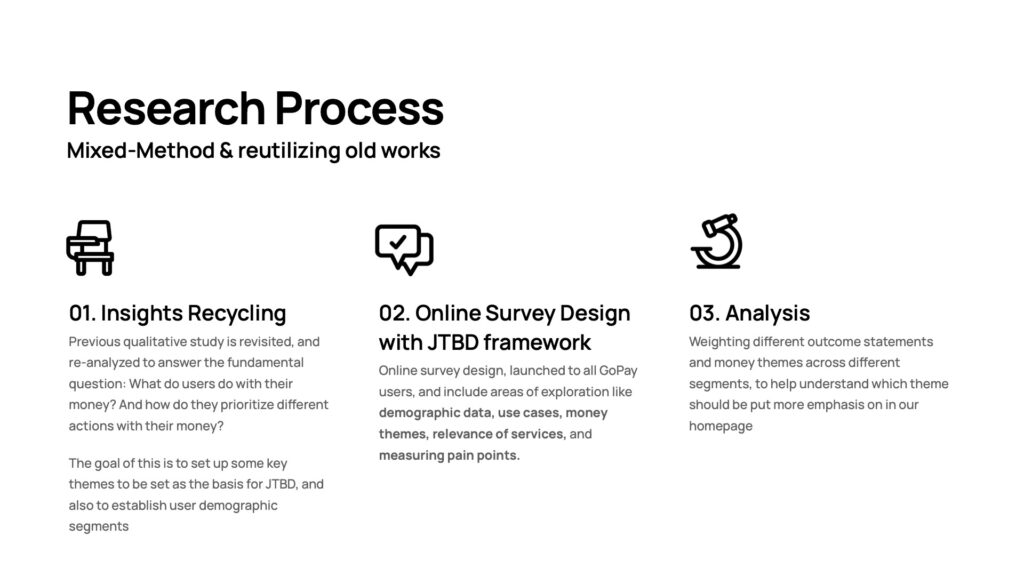
Let’s talk a bit about what is Jobs-to-be-done framework? A JTBD framework is a tool for product development, with the key activities of understanding what are the goals that the users want to achieve with our solution. This is where the qualitative insights recycling play an important role. Based on our understanding of the users, we analyze different actions that the users usually do with their money, and come up with some themes, such as: allocating money for the future, manage and partition my money, buy something I don’t have money for today, routine monthly expenses, making day-to-day payments, sending and receiving money from people.
Those themes now serve as a building block for our quantiative survey theme. We broken down each theme into some key actions / outcome statements that users wanted to achieve.
For example: allocating money for the future can be broken down into different outcome statement that we hypothesize important for the users, such as:
- I often forget to set aside money to save and I don’t know when I can start saving
- Sometimes I lose motivation to save again because I don’t have a definite financial goal.
- I am afraid that savings will be used for urgent and unplanned needs.
- etc.
We put these different outcome statements as well in the questionnaire, along with basic questions like demographic data and the big money themes. The structure of the quantitative survey now looks a bit like this in overview:
| Themes | Questions | Analysis Plan |
| Demographic information | – Age – Profession – Monthly income – etc. | Demographic to be crossed and clustered with preference in themes and outcome statements |
| Relevance of different themes | – From these themes, which themes resonate the most with you? – How do you usually do these money-themes? | Clustering into high, medium, or low relevance, based on frequency of activities |
| Theme-specific outcome statement assessment | – These are the statements in which related to the themes you chosen above. How would you rate the importance, and your satisfaction in dealing with these themes? | Weighting and scoring different outcome statement |
The Results
Some of the most basic results to our analysis looks a little bit like this
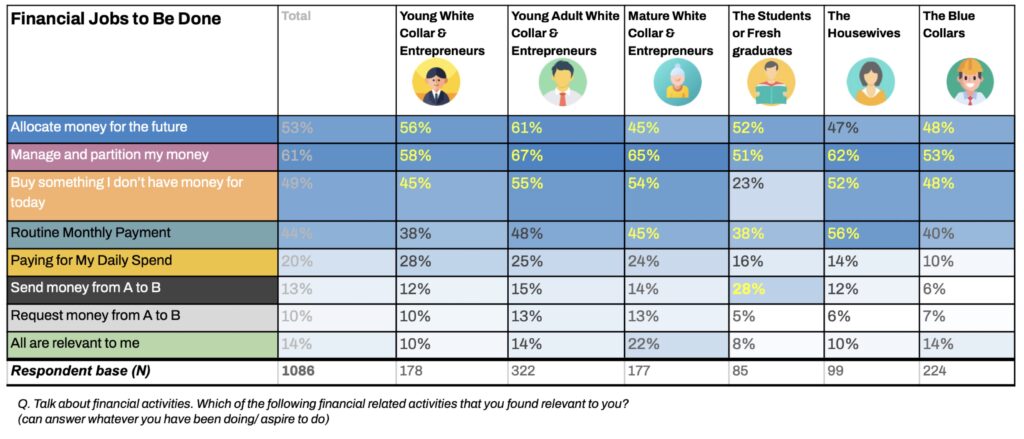
There are some conclusions that we drawn and push forward to the product team. Some of the main insights we can get:
- Generally, users think and worry more about savings when dealing with their money. Connecting this with our qualitative insights, it represents some of the biggest worry our users have.
- Visibility and transparency of expense record is also crucial for a financial app, as it’s the main “dashboard” that the users need to see first, before making any money-related decisions
- Sending money, although have some of the biggest use cases, don’t really score high in frequency, however, convenience of doing so is highly valued.
Impact of this research then changes the design for the future Gopay homepage. From focusing on paylater products (we hypothesize that BNPL should be the hero feature after payments), into something that solve the spending tracker, money management, and savings first.
As per this article is written, the work for the revamp in Gopay is still happening….